Software Stocks: The Rally Faces Its First Real Test
|
Software Stocks: The Rally Faces Its First Real Test Software has staged one of the sharper recoveries of the summer. The iShares Expanded Tech-Software Sector ETF (IGV) has climbed roughly 18% since its July 23 low, meaningfully outperforming the Nasdaq 100 and the Magnificent Seven over that stretch. The bounce follows a painful first half in which AI disruption fears compressed valuations across the sector. Investors worried that generative and agentic AI would erode pricing power and seat-based models in traditional enterprise software. That narrative is now being stress-tested by actual results showing AI as an additive revenue stream rather than pure cannibalization. What’s Driving the MoveTwo forces are at work. First, capital has rotated out of semiconductors and pure AI infrastructure names as investors reassess the durability of hardware spending cycles. Second, recent earnings from several software platforms have delivered concrete AI monetization metrics that the market can underwrite:
BofA and others have begun raising price targets on a group of names as the extinction narrative cools, though the bank remains more cautious on Adobe, where AI-first ARR is still a small percentage of the total and competitive intensity in creative tools remains elevated. Today’s Catalyst: IntuitIntuit reports fiscal fourth-quarter results after the close. Consensus sits near $4.27 billion in revenue (roughly +11.5% year-over-year) and non-GAAP EPS of about $3.59 (roughly +30%). Management has guided revenue growth of 11–12% for the quarter. This is a clean test of whether a scaled software platform with high incremental margins and sticky workflows can continue compounding while integrating AI into tax, accounting, and small-business tools. Watch guidance for fiscal 2027, any commentary on AI contribution, and free-cash-flow conversion. Intuit has already demonstrated the ability to expand margins even while investing; a clean print would reinforce the broader sector recovery. A Simple Framework for Software in This EnvironmentThe companies most likely to sustain the rally share a few characteristics:
Cybersecurity and infrastructure-adjacent software have generally held up better than pure application software throughout the year, reflecting the “scaffolding” demand created by AI deployment itself. Risks Still PresentThe sector is not out of the woods. Customer capex prioritization toward AI hardware and infrastructure can still delay software deals, as IBM’s earlier miss illustrated. Competitive intensity from AI-native tools remains real in some categories. And the recent move in IGV has been sharp enough that a soft set of earnings or guidance could trigger a quick pullback. Still, the combination of compressed valuations, improving AI monetization evidence, and the inherent operating leverage of scaled software platforms creates an asymmetric setup for patient capital. Earnings this week—starting with Intuit tonight—will provide the next data points on whether the summer rally has legs or was simply a relief bounce. Focus on the names that convert revenue growth into free cash flow at high rates. In software, that has always been the durable edge. |
Welcome to Golden Door
Learn about the latest technology investments here.
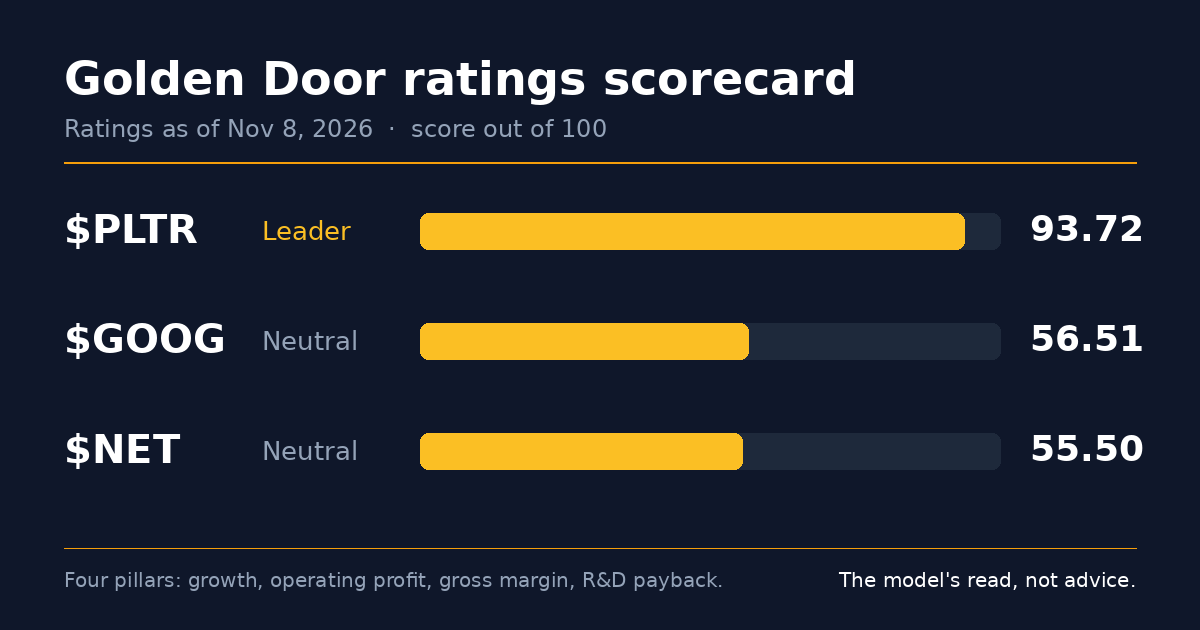
Does $ANT own the toll gate, or rent it? Anthropic's offering terms are public, and they put one question in front of every software owner: does $ANT own the toll gate, or rent it? A toll gate is the point in a workflow that every transaction has to pass through. Whoever owns it sets the price. Whoever rents it pays the owner first and keeps what is left. $ANT has the traffic. What it does not obviously have is the road. Its compute comes from the same chip and cloud companies that are now...
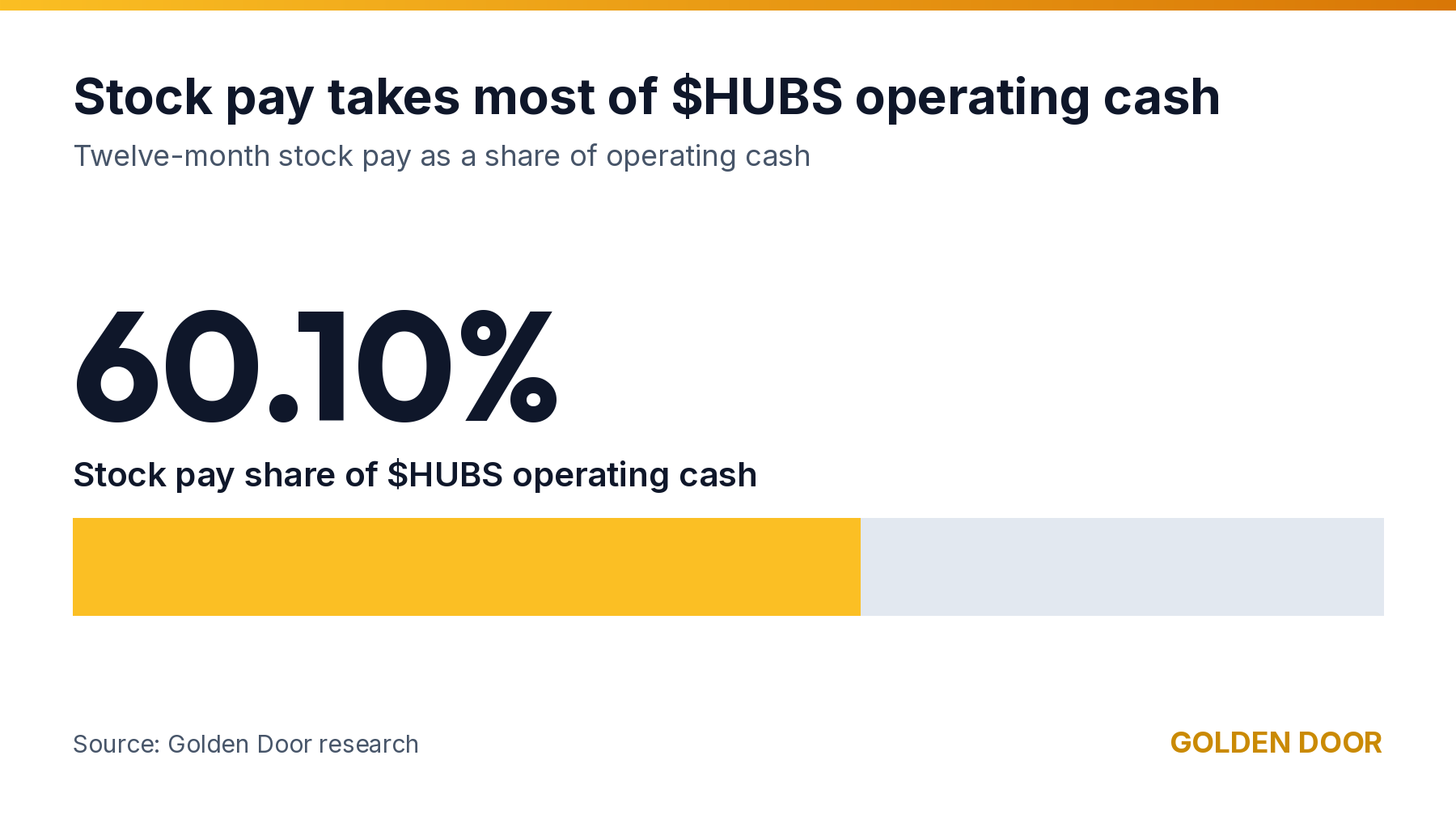
The open Today's theme: who really pays for stock pay, and what a true toll looks like by comparison. $WDAY: stock pay takes 53.42% of operating cash, absorbed by $2.92B of buybacks. $HUBS: $514.71M of twelve-month stock pay takes 60.10% of operating cash. $VRSN: a 66.93% operating margin on contracted .com fee steps with almost no capital need. $WDAY: The backlog is real, and so is the second payroll Workday holds $27.40B of subscription backlog and grew its 12-month backlog 14%. Q2 GAAP...
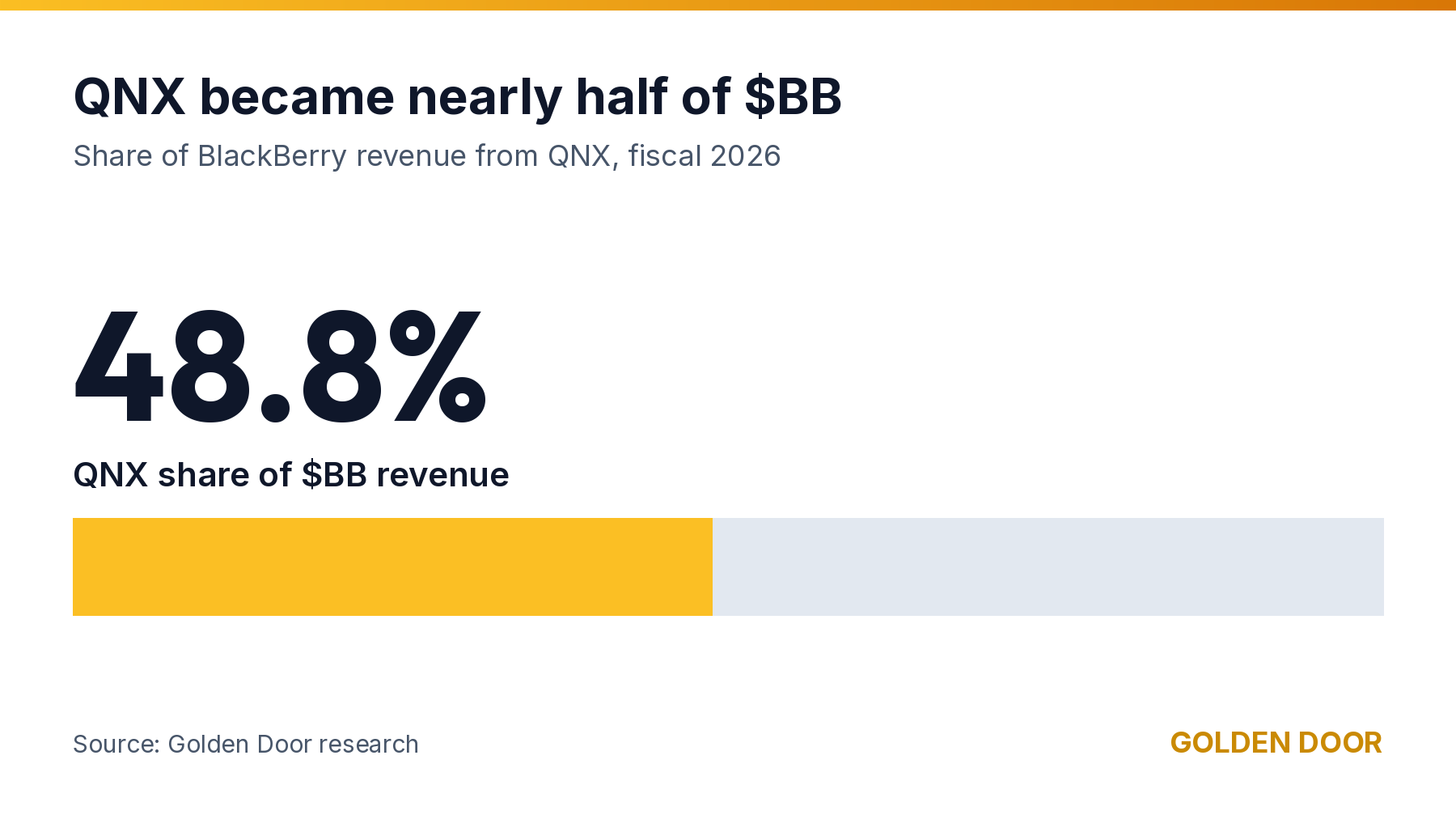
The open Today's theme: the business hiding inside a familiar name is often the one that decides the outcome. $MSFT: Q1 FY27 revenue rose 19% to $92.3B and Azure grew 48%. Microsoft's results $GEN: revenue grew 12% to $1.369B and the FY27 outlook went up. Gen's results $BB: QNX went from 28.4% of revenue in fiscal 2024 to 48.8% in fiscal 2026. Payroll without the hiring: $ADP revenue grew 6.74% while client employment grew 1%, and $PAYX PEO and Insurance grew 11.70% against 4.28% for the...