$BB is now half QNX
The openToday's theme: the business hiding inside a familiar name is often the one that decides the outcome.
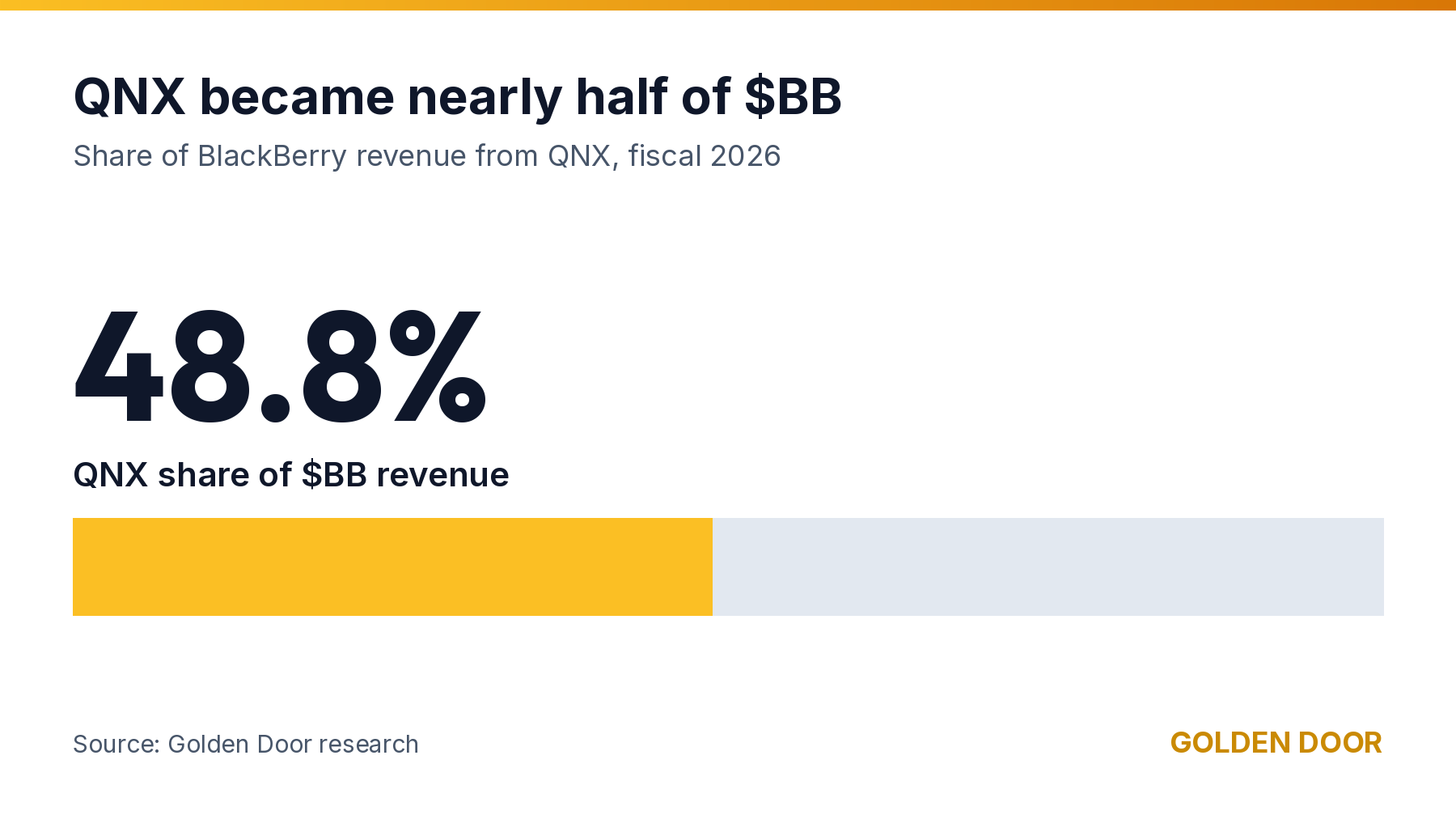
$BB: The takeover story ended when QNX became the companyFor years the case for BlackBerry was what a buyer might pay for the pieces. That framing is out of date. QNX, the embedded operating system business, went from 28.4% of revenue in fiscal 2024 to 48.8% in fiscal 2026. In Q2 it was $80.3M of $163.3M of revenue, grew 27.26%, and ran at an 86.80% adjusted gross margin. It also earns the most segment EBITDA of BlackBerry's three businesses. The rest of the company is not keeping pace. Secure messaging barely moved in Q2, and a one-off patent licensing deal lifted total growth to 26.00%. Set that deal aside and the growth story is almost entirely QNX. Our thesis: BlackBerry is now an embedded software royalty business with a legacy security arm attached. QNX carries a royalty backlog of about $950M, revenue that arrives as the software it sits in ships. That changes the question an owner should ask. It is no longer what a buyer would pay for the parts. It is how durable the QNX royalty stream is, how fast it compounds, and what the rest of the company costs to carry while it does. What to watch: QNX's share of revenue in the next print, whether growth holds without one-off licensing help, and whether the backlog keeps converting. If secure messaging stays flat, the mix shift does the work by itself. Read the $BB takeover research Read the $BB QNX research
Quick hits
$PAYX: The faster engine now carries Paycor's debtPaychex grew Q1 revenue 5.88% to $1.63B. The headline hides two businesses moving at different speeds. Management Solutions, the payroll and HR core, grew 4.28%. PEO and Insurance grew 11.70%, nearly three times as fast. This is the first quarter that the whole company carries the Paycor debt, so the split between the two engines matters more than it did a year ago. That gap matters because the core is the part with the toll. Payroll is sticky, mission critical and painful to switch. The PEO line grows faster, but it bundles benefits and insurance into the relationship, so it is a different kind of revenue with a different kind of risk. Our thesis: Paychex is leaning on its faster engine while it absorbs a large acquisition. All of it now carries $4.56B of Paycor debt. A company growing its core in the low single digits has less room for error while it carries acquisition debt, so the PEO line has to keep doing the heavy lifting. The margin is holding so far: operating margin rose to 37.98% from 35.19% as SG&A fell while revenue grew. Paychex paid $424.1M of dividends in Q1 and made no buybacks. What to watch: whether Management Solutions growth holds at Q1's 4.28% or slips, whether PEO and Insurance keeps growing at double digits, and how quickly the Paycor debt comes down. The payroll toll is intact. The open question is how much of the growth now depends on the line with the thinner toll. $ADP: Payroll growth without the hiringADP grew fiscal 2026 revenue 6.74% to $21.95B. Employment at its clients grew only 1%. For a business that has long grown alongside the number of paychecks it processes, that gap is the story. Employer Services retention was 92.1% and new business bookings grew 6%. The filing shows where the rest came from: pricing, new bookings, $1.35B of interest on client funds, and a PEO line that includes pass-through costs. Each source has a different quality. Pricing and bookings are the franchise at work. Interest on client funds depends on rates. Pass-through costs lift revenue without lifting much profit. The client funds interest alone, $1.35B against $21.95B of revenue, is about 6.17% of the total. PEO pass-throughs, which carry zero margin, rose $318.3M in the year. Our thesis: ADP and Paychex are telling the same story from two sides. Payroll is a toll road, but the traffic is barely growing, so growth comes from raising the toll, selling more lanes and earning interest on the float. That works, but it leaves growth more exposed to rates and to pricing pushback than the headline number suggests. What to watch: how much of next year's growth comes from client funds interest versus pricing and new bookings, and whether employment at clients stays near 1%. When the float and the price increases carry the year, the toll is still being paid, just by a different lever. A drop in Employer Services retention below 92% would be the first sign of pressure. By the numbers6.74% vs 1%$ADP fiscal 2026 revenue growth against employment growth at its clients. The gap is pricing, bookings and float, not hiring. The model's read, not advice. Rebuild the numbers yourselfFull Access opens the Financial Engine: filed SEC statements, a 5-year DCF, a reverse-DCF growth solver and the R&D Return benchmark for 250 public software companies. $1,000, one-time. No subscription. None of this is a price target or a rating. |
Welcome to Golden Door
Learn about the latest technology investments here.
The open Tonight two very different software balance sheets face the same question: is the cash turning into returns? The Nasdaq rose 1.2% as the rally in compute names ran into a second day. Source $GWRE fell 6.6% after agreeing to pay $1.7B in cash for underwriting software maker hyperexponential. Source $CVLT slid nearly 10.9% before the open even as subscription ARR grew 20%. Source $MSFT: The best software franchise is now a capacity company Microsoft reports fiscal first quarter results...
Software Stocks: The Rally Faces Its First Real TestAugust 25, 2026 Software has staged one of the sharper recoveries of the summer. The iShares Expanded Tech-Software Sector ETF (IGV) has climbed roughly 18% since its July 23 low, meaningfully outperforming the Nasdaq 100 and the Magnificent Seven over that stretch. The bounce follows a painful first half in which AI disruption fears compressed valuations across the sector. Investors worried that generative and agentic AI would erode pricing...
ADBE Return on Equity Analysis: Navigating the Digital Media Landscape A daily market insight into Adobe's financial performance, growth prospects, and competitive positioning. 6/10/2025 Daily Market Insights Your daily dose of market intelligence6/10/2025 Return on Equity Scorecard: ADBE Adobe (ADBE): A Creative Powerhouse in a Shifting Landscape Adobe (ADBE) remains a dominant player in the digital media and marketing solutions space, but recent performance reveals a nuanced picture. While...