Buybacks are paying the $HUBS stock bill
The openToday's theme: who really pays for stock pay, and what a true toll looks like by comparison.
$WDAY: The backlog is real, and so is the second payrollWorkday holds $27.40B of subscription backlog and grew its 12-month backlog 14%. Q2 GAAP operating margin rose to 11.82%. On the surface, that is a durable subscription franchise getting more profitable. Two details complicate the picture. A $305M tax benefit lifted net income, so the bottom line flatters the quarter. And stock pay takes 53.42% of operating cash, absorbed by $2.92B of buybacks. In plain terms, more than half of the cash the business generates goes to offsetting the shares it hands to employees. Our thesis: Workday's backlog is a genuine moat. Customers have signed multiyear commitments for systems that are hard to rip out. But owners only keep what is left after the second payroll. When buybacks mostly absorb dilution, they are a cost of running the company rather than a return of capital. What to watch: whether 12-month backlog growth holds near 14%, whether GAAP operating margin keeps rising without tax help, and whether stock pay falls as a share of operating cash. A falling share would mean the backlog is finally turning into owner cash. Quick hits
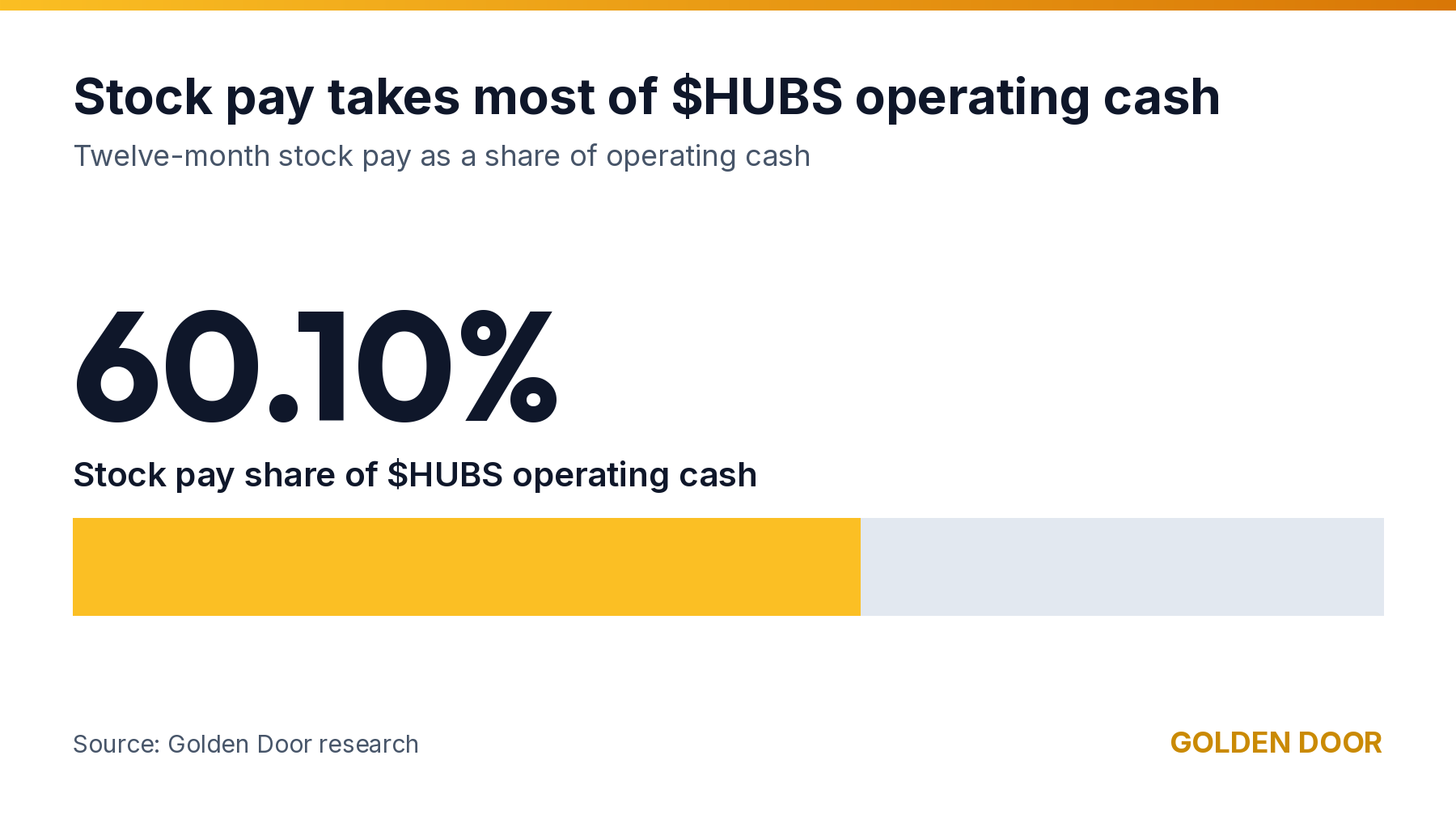
$HUBS: Customers grow, and buybacks cover the sharesHubSpot grew Q2 revenue 19.83% and customers 14.35% to 306,446. That is a broad base still adding logos at a healthy clip, and operating cash is strong. The cost sits underneath. Twelve-month stock pay was $514.71M, which takes 60.10% of operating cash. Over six months, HubSpot spent $748.70M on buybacks, which offset the dilution. The cash is real, but most of it is spoken for before an owner sees it. Our thesis: HubSpot and Workday are the same pattern at different stages. Both have real franchises, both generate strong operating cash, and both route a large share of that cash back into absorbing stock pay. Growth that looks self-funding on an adjusted basis is partly funded by owners through buybacks. What to watch: whether customer growth keeps pace with revenue growth, and whether stock pay falls as a share of operating cash. If it does, the buyback can shift from defense to a genuine return. If it does not, the headline cash flow overstates what owners keep. $VRSN: The toll that needs almost no road workFor contrast, consider a business with almost no second payroll problem and almost no capital need. VeriSign runs the .com and .net registries under contract, with 182.5 million names. It has the right to raise the .com fee up to 7% a year. That contract is the moat. Every .com name pays the registry, and the fee steps are written in advance. Operating margin is 66.93%. Growth comes from contracted price steps rather than from new data centres or a sales force chasing logos. Our thesis: VeriSign is close to a pure toll gate. Most software companies have to keep spending, on capacity, on stock pay or on acquisitions, to defend their position. VeriSign's position is defined by contract, so the cash it generates is not consumed by the business that produced it. What to watch: whether the name count holds near 182.5 million, and whether the contracted fee steps keep being used. A toll gate is only as good as the traffic through it, so name count is the variable that matters most. By the numbers60.10%The share of $HUBS operating cash taken by twelve-month stock pay. At $WDAY it is 53.42%.
Reply HUBS and I'll send you the downside case. The model's read, not advice. Rebuild the numbers yourselfFull Access opens the Financial Engine: filed SEC statements, a 5-year DCF, a reverse-DCF growth solver and the R&D Return benchmark for 250 public software companies. $1,000, one-time. No subscription.
None of this is a price target or a rating. |
Welcome to Golden Door
Learn about the latest technology investments here.
The open Today's theme: the business hiding inside a familiar name is often the one that decides the outcome. $MSFT: Q1 FY27 revenue rose 19% to $92.3B and Azure grew 48%. Microsoft's results $GEN: revenue grew 12% to $1.369B and the FY27 outlook went up. Gen's results $BB: QNX went from 28.4% of revenue in fiscal 2024 to 48.8% in fiscal 2026. Payroll without the hiring: $ADP revenue grew 6.74% while client employment grew 1%, and $PAYX PEO and Insurance grew 11.70% against 4.28% for the...
The open Tonight two very different software balance sheets face the same question: is the cash turning into returns? The Nasdaq rose 1.2% as the rally in compute names ran into a second day. Source $GWRE fell 6.6% after agreeing to pay $1.7B in cash for underwriting software maker hyperexponential. Source $CVLT slid nearly 10.9% before the open even as subscription ARR grew 20%. Source $MSFT: The best software franchise is now a capacity company Microsoft reports fiscal first quarter results...
Software Stocks: The Rally Faces Its First Real TestAugust 25, 2026 Software has staged one of the sharper recoveries of the summer. The iShares Expanded Tech-Software Sector ETF (IGV) has climbed roughly 18% since its July 23 low, meaningfully outperforming the Nasdaq 100 and the Magnificent Seven over that stretch. The bounce follows a painful first half in which AI disruption fears compressed valuations across the sector. Investors worried that generative and agentic AI would erode pricing...