Does $ANT own the toll gate, or rent it?
Does $ANT own the toll gate, or rent it?Anthropic's offering terms are public, and they put one question in front of every software owner: does $ANT own the toll gate, or rent it? A toll gate is the point in a workflow that every transaction has to pass through. Whoever owns it sets the price. Whoever rents it pays the owner first and keeps what is left. $ANT has the traffic. What it does not obviously have is the road. Its compute comes from the same chip and cloud companies that are now buying its stock, and cheaper models are pressing on price from below. So this edition runs every section through the same test: who owns the record, who owns the connection, who prices on outcomes, and who is spending R&D on the gate rather than on features. Two research pieces, three ratings, four signals and one free piece of industry research, all pointed at that one question. Two research pieces$VERX: a sticky record with thin owner cash. Vertex runs the indirect-tax engine inside SAP and Oracle ERPs, with certified connectors into Workday, Microsoft Dynamics 365 and Coupa. Trailing revenue reached $787.44M, up 15.16%. But GAAP operating income was a $13.34M loss, capital spending (mostly capitalised software) took $77.67M, and stock pay took $57.00M. Owner cash was $38.94M, or 4.94% of revenue. What it means for $ANT: Vertex is the clearest example in our coverage of a company that owns the record and still struggles to keep the toll. Its tax rules sit inside the ERP, ripping it out risks audit penalties, and it prices on transaction volume rather than seats. That is a real gate. But every new e-invoicing mandate forces it to rebuild rule tables, so the cost of keeping the gate open eats most of the cash. If $ANT ends up owning workflows, it will face the same question: does maintaining the gate cost more than the gate collects? Read the $VERX research $U: compute costs are eating the margin. Unity grew trailing revenue 13.6% to $2.03B, helped by its Vector ad platform. But gross margin fell to 64.85% from 74.17% as training and serving its bidding models in public clouds pushed up cost of revenue. Gross profit dollars actually fell even as revenue grew. The GAAP operating loss reached $616.0M, with $341.93M of stock pay. What it means for $ANT: Unity is what renting the road looks like. It rebuilt its ad engine on machine-learning models and the cloud bill arrived before the extra gross profit did. Every software company putting superintelligence into its product is running this experiment right now, and $ANT sits on both sides of it: it collects from companies like Unity while paying its own compute suppliers. The margin line tells you who is winning. Read the $U research Three ratings
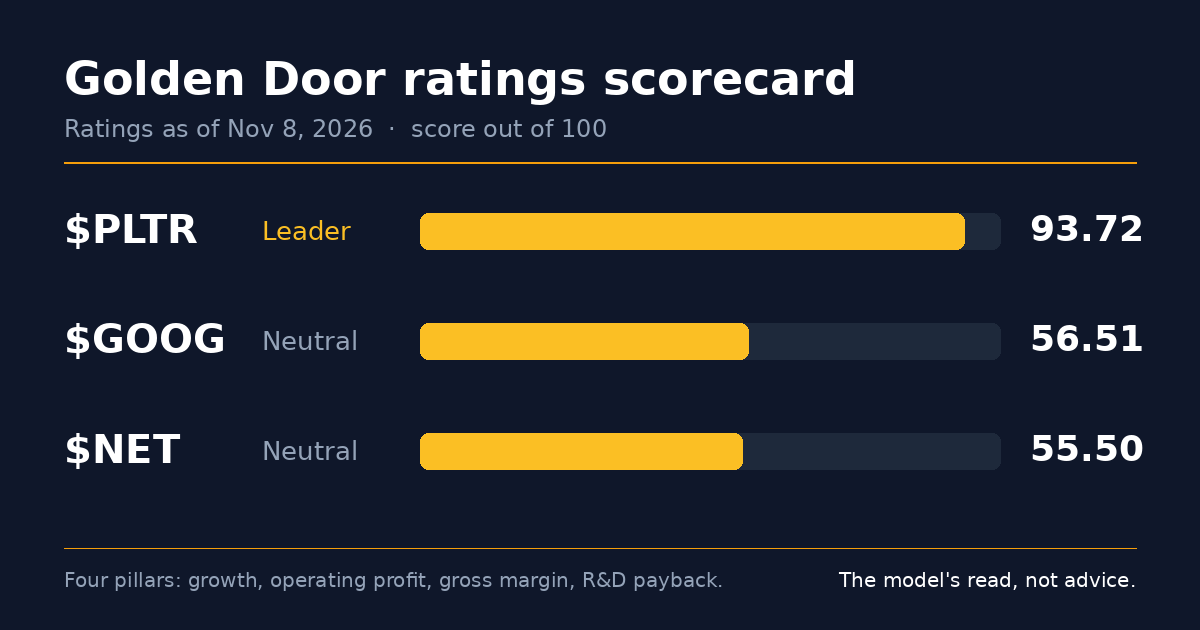
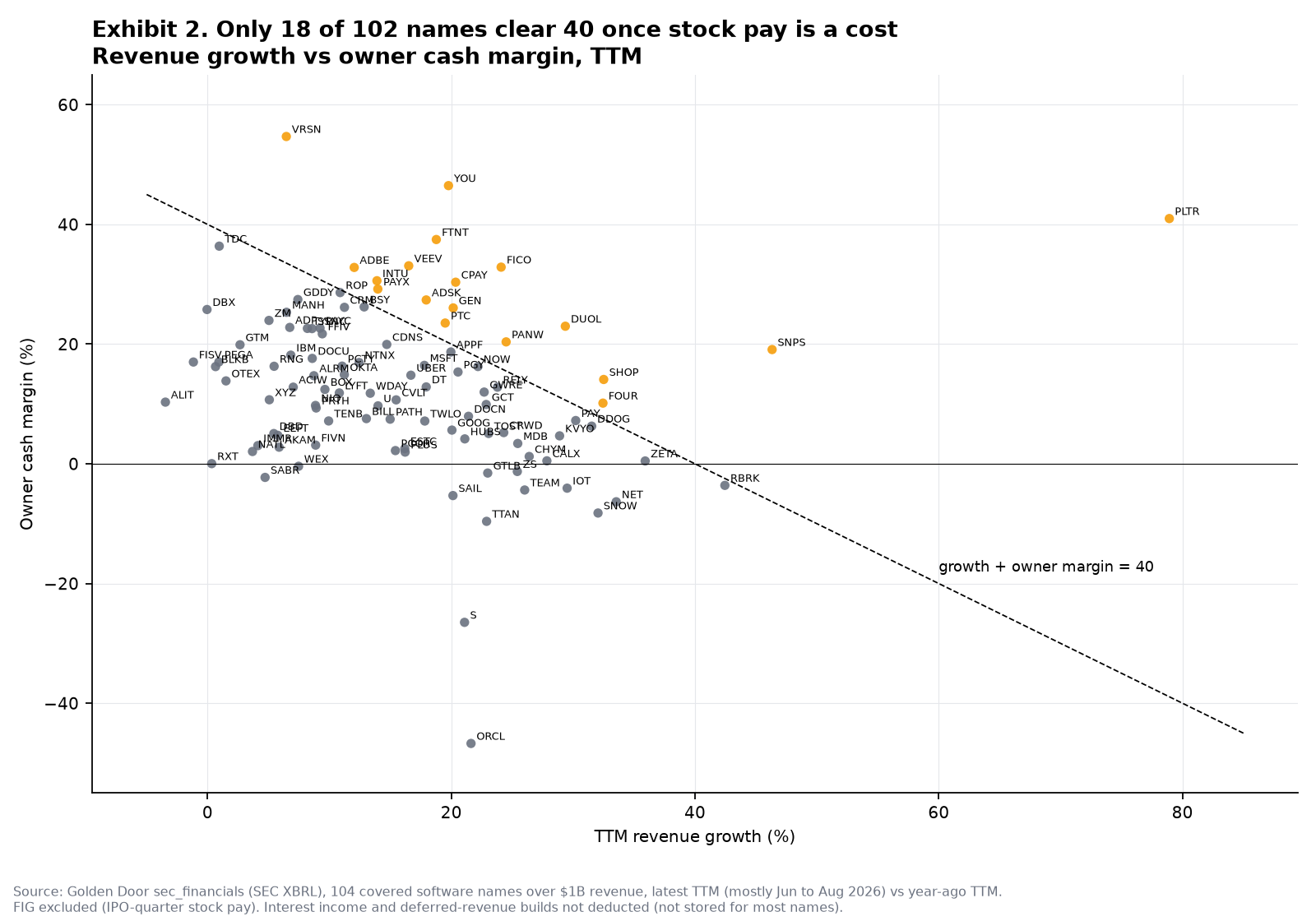
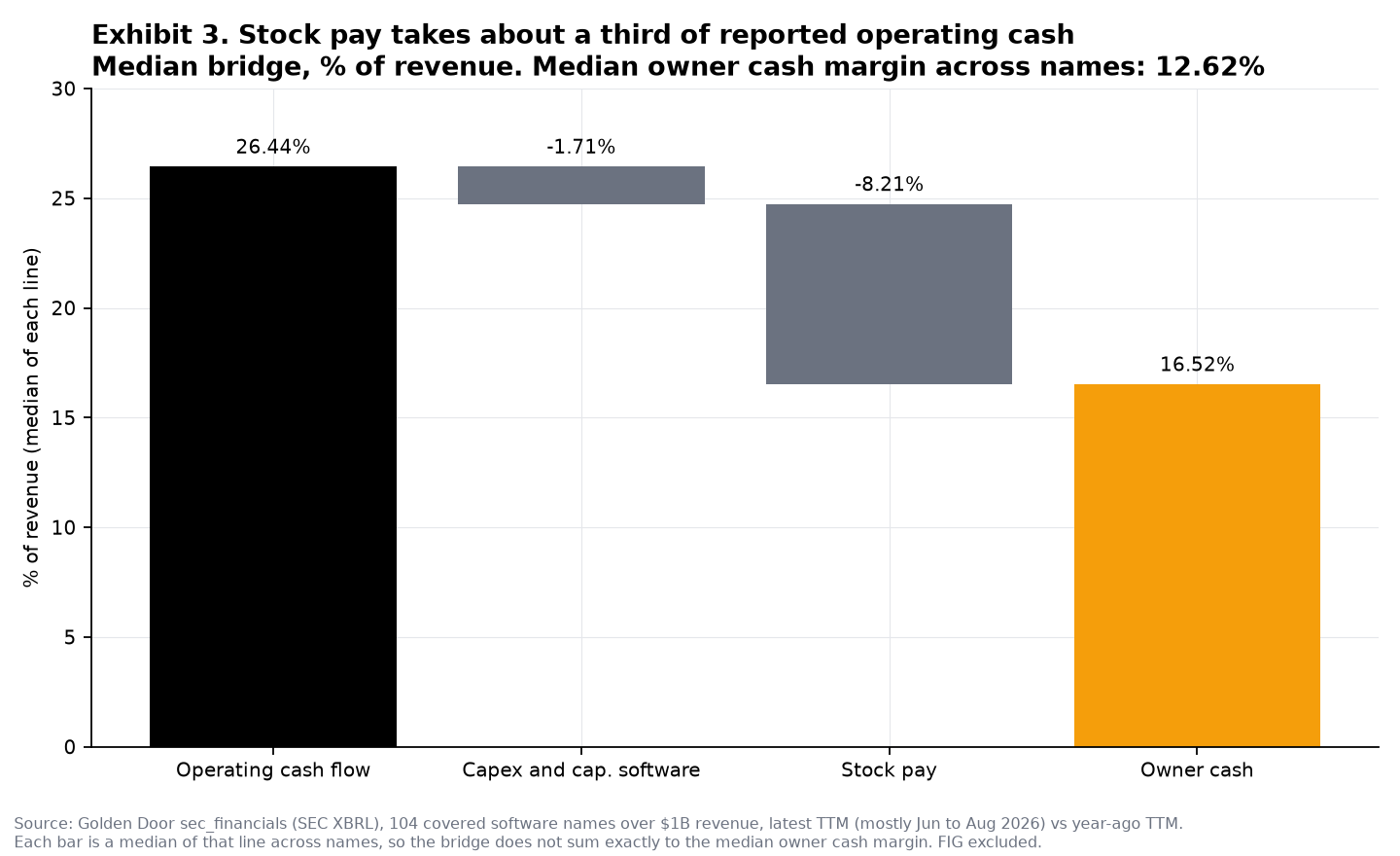
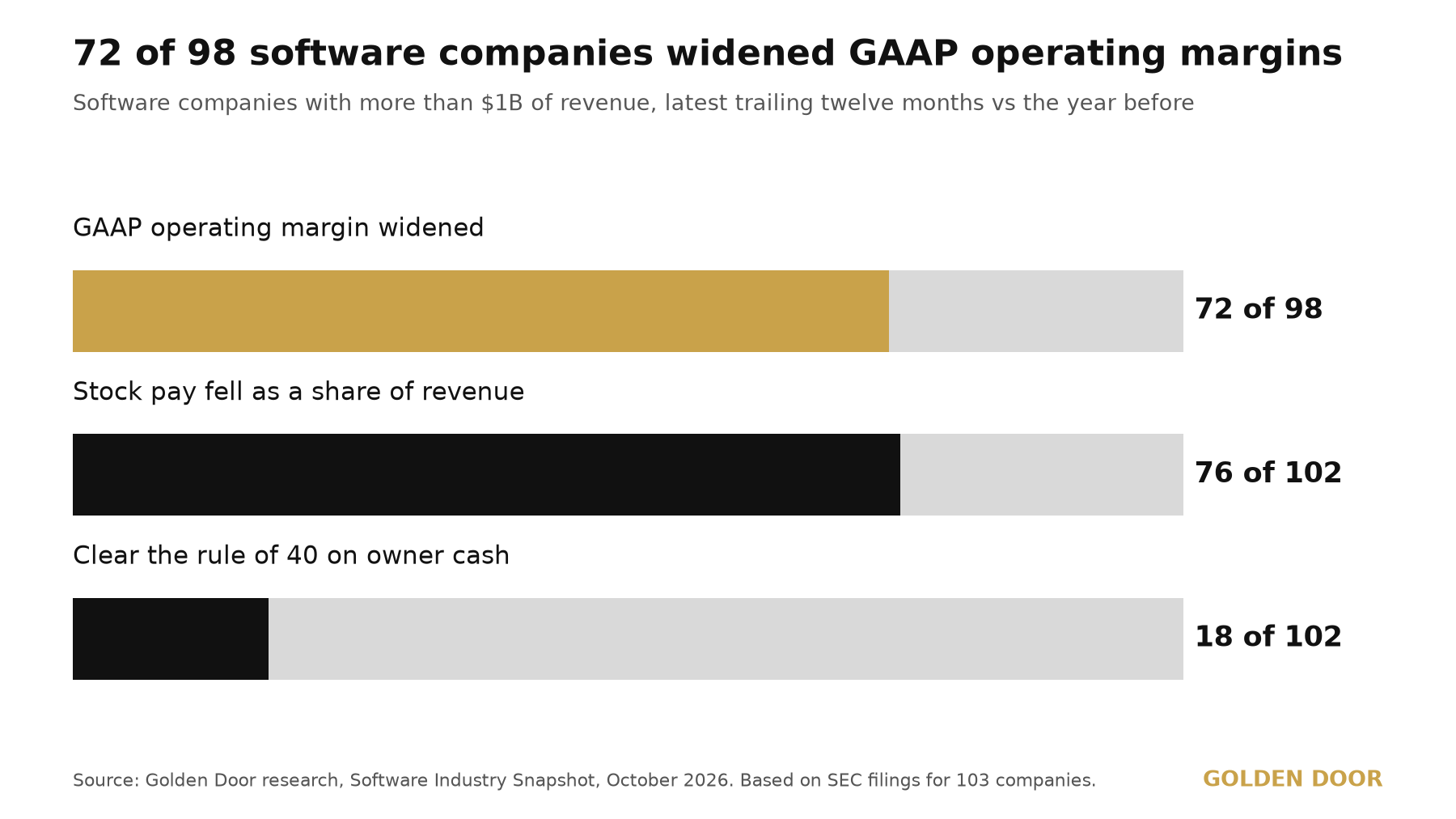
Nov 8 was the first release under our four-pillar method (growth, operating profit, gross margin, R&D payback), so there is no earlier rating to compare. These are current ratings, not changes. Each score ranks a company against our software index on all four pillars. $PLTR: Leader, 93.72 of 100, the top score in our software index. What drives it: profit and R&D payback. $PLTR ranks 97.67 on operating profit and 100 on payback, the highest reading in the index, with gross margin at 90.7. On our test, it is the closest thing in software to a company that owns the gate: customers run their operations inside it, and the spending to build it is already paying back. See the $PLTR rating $GOOG: Neutral, 56.51. What drives it: a split. Alphabet ranks 93.8 on operating profit but only 12.4 on gross margin and 34.11 on growth, the profile of a company carrying a heavy compute bill. It is also one of the companies financing $ANT, which makes it a landlord and an investor at once. See the $GOOG rating $NET: Neutral, 55.50. What drives it: growth against profit. Cloudflare ranks 91.47 on growth but 10.85 on operating profit. It sits in front of a growing share of agent traffic, which is exactly where a connection gate would live, but it has not yet disclosed what its toll products earn. See the $NET rating Four signals$ANT's suppliers are now its shareholders. Anthropic's run-rate revenue was about $81B at Oct 31 against $900.9B of purchase and lease commitments, mostly compute, and $GOOG and $NVDA are each buying $10B of $ANT stock at the IPO price, per Patrick Moorhead. Commitments more than ten times a year of revenue, owed largely to the companies writing the checks, is what renting the road looks like at scale. Top-end reasoning is expensive and capped. The $200 Claude plan buys about $15,000 of Opus 5.5 a month but only about $3,000 of Fable, which is capped at 50% of the weekly limit, per Theo. Rationing the best model tells you its cost is still high. Software that routes expensive planning onto cheaper execution keeps more of the margin. Small models just got much cheaper. $META launched Muse Ember, which nicbstme says beats Haiku at 95% lower cost and GPT-6 Luna at about 67% lower cost. Price pressure from below squeezes any model company that charges for raw capability. Software that owns the record keeps the savings, while thin wrappers lose their reason to exist. The record is the product, the seat is not. Andrew Qu says that since SaaS got MCP connectors, a lot of what he pays for is "a database in a trench coat." If agents reach the data directly, the interface stops earning a toll and the record has to earn it alone. Vendors that own the record can still charge; vendors that only owned the screen are exposed. Free research: Software Is HarvestingOur free industry research, Software Is Harvesting, published Oct 25 and corrected Oct 26 and 27, asks what the listed software industry is doing with its growth. It covers 103 companies with more than $1B of trailing revenue each, $1,450.41B combined, all built from SEC filings. Here is the short version, and why it matters for the toll-gate question. The industry is harvesting, not reinvesting. The median company grew revenue 15.41%. That is healthy, but the bigger change is what management teams are doing with it. GAAP operating margins widened at 72 of 98 companies with comparable figures for both years. Stock pay fell as a share of revenue at 76 of 102. Diluted share counts fell at 54 of 87. Teams are taking the gains from slower hiring and sharper cost control instead of spending them on the next leg of growth. Owner cash is much thinner than stated cash. The median company turns 26.44% of revenue into operating cash. Take out capital spending and capitalised software (1.71 points at the median) and stock pay (8.21 points), and the median owner cash margin falls to 12.62%. Stock pay is a real cost paid in shares rather than cash, and at the typical software company it is several times larger than capital spending. Measured on owner cash, only 18 of 102 companies pass the familiar rule of 40, which adds revenue growth to a profit margin.
The 18 include Adobe, Autodesk, Fortinet, Intuit, Palantir, PTC, Shopify, Synopsys, Veeva and VeriSign. Some are compounders with very high margins and modest growth: VeriSign's owner cash margin is 54.69%. Palantir pairs fast growth with a 40.98% owner cash margin, which no other company in the cohort comes close to. Most of the industry sits between 0% and 25% owner cash margin. The biggest companies are now capital-heavy. Weighted by revenue, the owner cash margin is 10.46%, below the median, because the largest names are spending on data centres for superintelligence workloads. Microsoft spends 34.94% of revenue on capex and Alphabet 29.70%, which cuts Alphabet's owner cash margin to 5.64%. Oracle's capital spending is 105.41% of revenue, turning a 65.40% operating cash margin into an owner cash margin of minus 46.72%. For the rest of the industry, capital spending barely matters. For the four largest, it now matters more than stock pay.
Stock pay sits where growth is fastest. Security companies pay a median 61.69% of their operating cash in stock; payroll and HR companies pay 5.38%. At 31 of 102 companies with positive operating cash, stock pay is more than half of it. The trend is improving, though: among the 20 largest names, stock pay fell as a share of revenue at 15. Gross margin is where superintelligence shows up first. Median gross margins sit in the 70s for infrastructure, horizontal applications and security, and far lower in payments. Inference costs run through cost of revenue, so the year-on-year change in gross margin is the line to watch. Unity is an early case of it going the wrong way. Why this matters for $ANT. The harvest is the backdrop for the toll-gate question. If software incumbents are cutting costs and buying back shares rather than rebuilding their products, the new workflow spending flows to whoever supplies the model and the compute. That is the bull case for $ANT. But the same research shows who is actually keeping the cash: the hyperscalers are spending it on concrete, and their owner cash margins are shrinking as a result. $ANT's $900.9B of commitments flows to exactly those companies. A model company that pays the landlords first is renting the gate until it proves otherwise. Horizontal applications, the group most exposed to agents replacing seats, is where we will see first whether the toll moves. What would prove the harvest thesis wrong: stock pay intensity rising again, or margin gains reversing as superintelligence spending moves from the hyperscalers into application budgets. The October and November earnings season is the test. Read the full free research, with all thirteen exhibits and the method notes. New researchToast ($TOST): Hold off, conviction 3 of 5. Toast's restaurant software and payment rails are a real toll gate. About 189,000 locations run on it, subscription ARR is $1.28B, and the two together drive more than 80% of adjusted EBITDA. The question is Toast Capital: $177M of lending gross profit in nine months, while $87M of credit losses sit in G&A. After $214M of stock pay, $604M of free cash flow over the last twelve months is closer to $312M of owner cash. Read the full research: https://www.goldendoorasset.com/research/tost-toast-hold-as-37-8-ynwp?utm_source=kit&utm_medium=email&utm_campaign=research_digest&utm_content=tost-kit-r BILL Holdings ($BILL): Avoid, conviction 4 of 5. BILL's Divvy card rebated 51.45% of gross card revenue in fiscal 2026. On July 1, 2026 it moved rewards into contra-revenue, which added 521 bps to non-GAAP operating margin with no cash benefit. After $211.70M of stock pay and $180.17M of card-receivable outflows, owner cash over the last twelve months is negative $36.56M. Read the full research: https://www.goldendoorasset.com/research/bill-strip-the-float-and-bill-3bby?utm_source=kit&utm_medium=email&utm_campaign=research_digest&utm_content=bill-kit-r Full Access is $1,000, one-time.
The model's read, not advice. None of this is a price target or a rating. |
Welcome to Golden Door
Learn about the latest technology investments here.
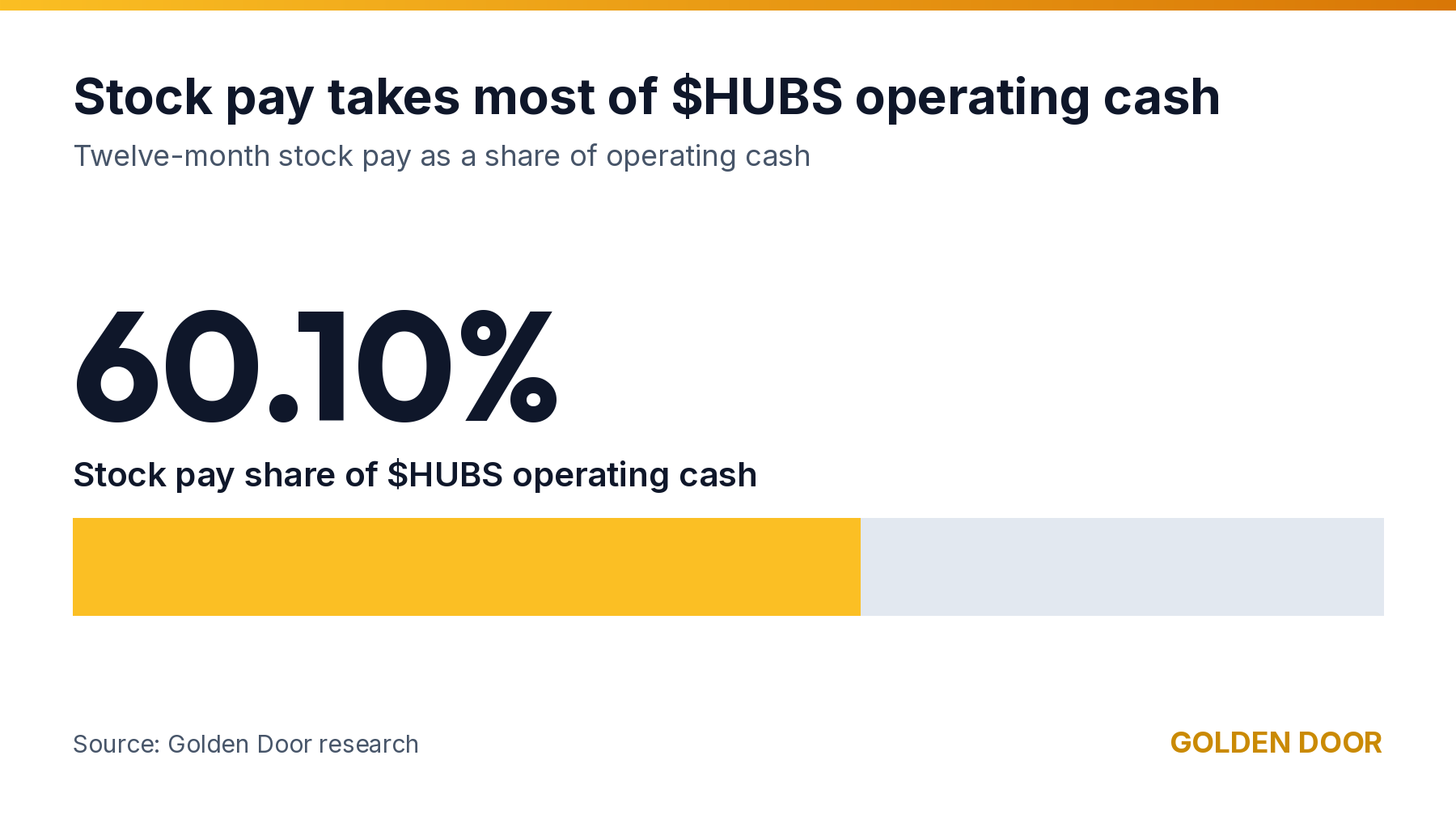
The open Today's theme: who really pays for stock pay, and what a true toll looks like by comparison. $WDAY: stock pay takes 53.42% of operating cash, absorbed by $2.92B of buybacks. $HUBS: $514.71M of twelve-month stock pay takes 60.10% of operating cash. $VRSN: a 66.93% operating margin on contracted .com fee steps with almost no capital need. $WDAY: The backlog is real, and so is the second payroll Workday holds $27.40B of subscription backlog and grew its 12-month backlog 14%. Q2 GAAP...
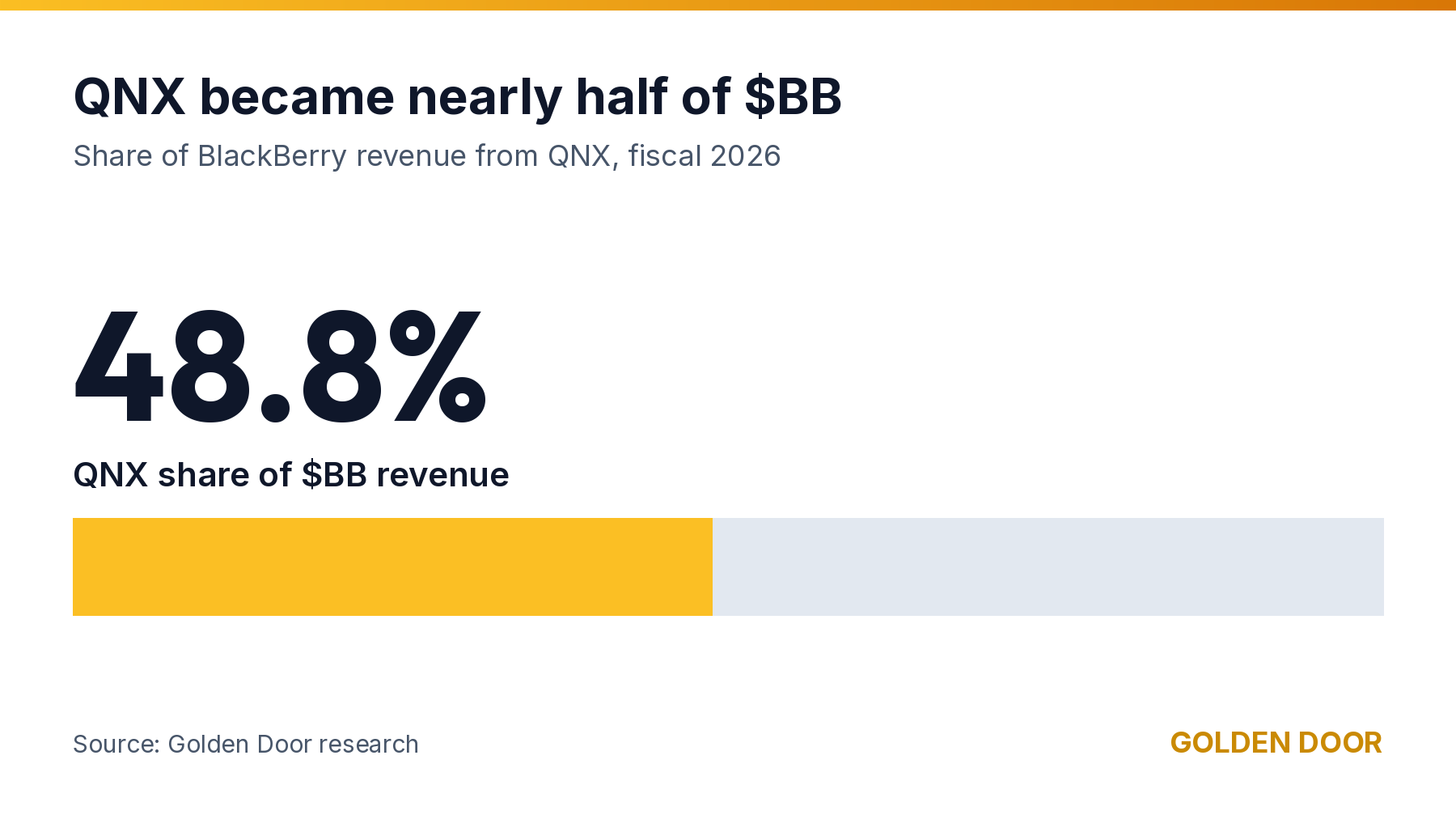
The open Today's theme: the business hiding inside a familiar name is often the one that decides the outcome. $MSFT: Q1 FY27 revenue rose 19% to $92.3B and Azure grew 48%. Microsoft's results $GEN: revenue grew 12% to $1.369B and the FY27 outlook went up. Gen's results $BB: QNX went from 28.4% of revenue in fiscal 2024 to 48.8% in fiscal 2026. Payroll without the hiring: $ADP revenue grew 6.74% while client employment grew 1%, and $PAYX PEO and Insurance grew 11.70% against 4.28% for the...
The open Tonight two very different software balance sheets face the same question: is the cash turning into returns? The Nasdaq rose 1.2% as the rally in compute names ran into a second day. Source $GWRE fell 6.6% after agreeing to pay $1.7B in cash for underwriting software maker hyperexponential. Source $CVLT slid nearly 10.9% before the open even as subscription ARR grew 20%. Source $MSFT: The best software franchise is now a capacity company Microsoft reports fiscal first quarter results...